
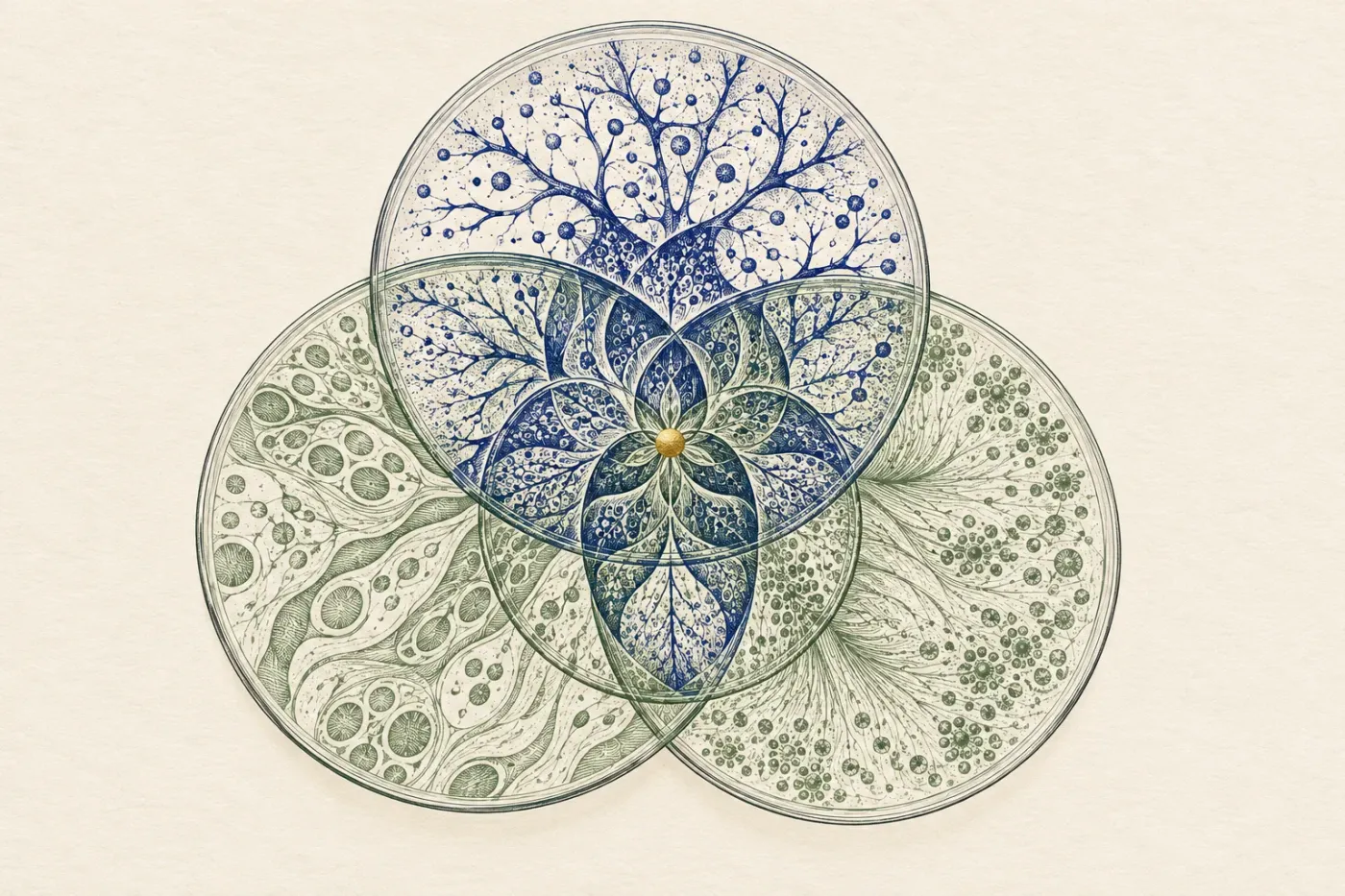
Cancer research produces many kinds of information: images, laboratory measurements, molecular signals, and clinical observations. Machine learning offers ways to study relationships across those inputs.
The useful question is specific: what can a model help us understand that we would otherwise struggle to see?
From a measurement to a pattern
A biomarker value is one piece of information. Its relationship to other measurements may be more informative than the value alone. A model can learn patterns across a panel and test how those patterns relate to a defined outcome.
That makes the choice of inputs important. Repeated measurements of similar information may add little. Complementary measurements can give the model another view of the biology.
Why we explain a mixture of experts
In a mixture-of-experts architecture, specialist models contribute to an interpretation. A gating layer considers their outputs in context. The aim is to give different biological questions room for different kinds of expertise.
Our interactive architecture lets you explore a full panel, a tiered sequence of measurements, and a disease-specific approach. Click a node to see what it contributes.
The work continues beyond training
A model learns from the data it receives. Study design, sample handling, missing information, and the people represented in that data all matter.
Testing on independent data helps establish how well a model travels beyond its development setting. In early detection, sensitivity and specificity also need to be understood by disease, stage, and population. That is where a promising pattern becomes a question that research can answer.
Sources and further reading
From the BioMarkIQ archive. Edited and updated on 17 October 2026.